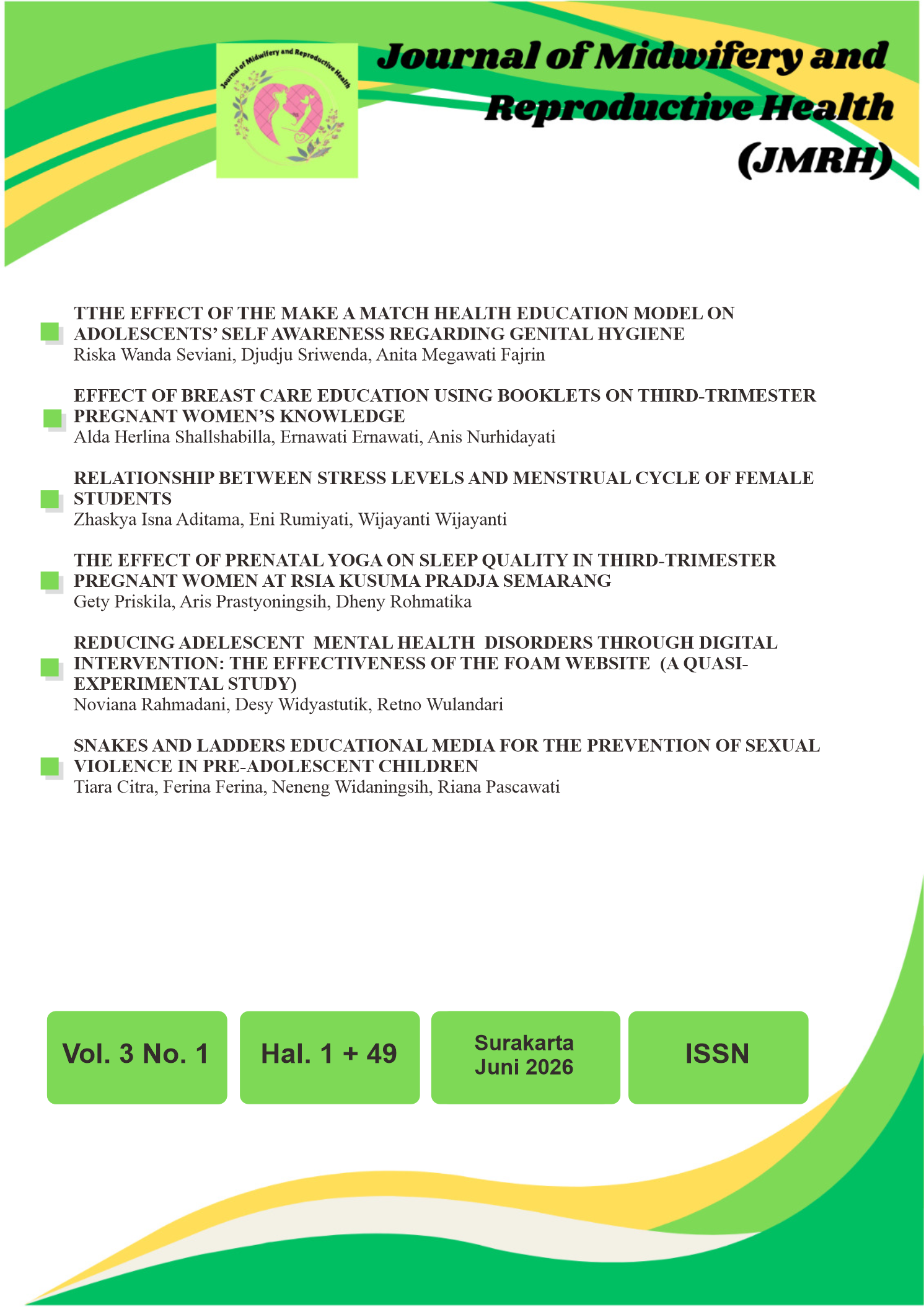
SNAKES AND LADDERS EDUCATIONAL MEDIA FOR THE PREVENTION OF SEXUAL VIOLENCE IN PRE-ADOLESCENT CHILDREN
DOI:
https://doi.org/10.34035/jmrh.v3i1.1929Keywords:
knowledge, pre-adolescent children, sexual education, sexual violence, snakes and laddersAbstract
Background: Child sexual abuse is a serious and increasingly prevalent issue each year, with long-term physical, psychological, and social impacts on victims. Children aged 8–9 years are in the stage of concrete operational cognitive development, during which they begin to understand cause-and-effect relationships and think logically about concrete situations. Therefore, an interactive, enjoyable, and developmentally appropriate educational approach is essential. One alternative educational medium is the Snakes and Ladders game. This study aims to determine the effect of the Snakes and Ladders educational game on improving knowledge about sexual abuse among pre-adolescent children.
Methods: This study employed a quasi-experimental design with a one-group pretest-posttest approach. The study was conducted at SDN 209 Antapani, Bandung City, from April to May 2025. The sample consisted of 30 pre-adolescent children aged 8–9 years, selected using a probability sampling method with random sampling. Data were collected using a questionnaire and analyzed with the Wilcoxon statistical test.
Results: The intervention resulted in a significant increase in knowledge (p < 0.05).
Conclusion: This indicates that the Snakes and Ladders game is effective in increasing children’s knowledge about sexual abuse.
References
Afiati, E., Prabowo, A. S., Handoyo, A. W., Dalimunthe, Z., Nurmala, M. D., Konseling, J. B., Sultan, U., & Tirtayasa, A. (2023). Edukasi pemahaman dan pencegahan kekerasan seksual pada anak sekolah dasar kota serang. 2023, 207–213.
Da Cruz, M. A., Gomes, N. P., Campos, L. M., Estrela, F. M., Whitaker, M. C. O., & Lírio, J. G. D. S. (2021). Impacts of sexual abuse in childhood and adolescence: An integrative review. Ciencia e Saude Coletiva, 26(4), 1369–1380. https://doi.org/10.1590/1413-81232021264.02862019
Dewi, R. (2022). Pentingnya Pendidikan Seks Pada Anak Usia Dini di Era Digital. Jurnal Al-Qayyaimah, 6(1), 32–37.
Dewiani, K., Purnama, Y., & Yusanti, L. (2020). Pendidikan Seks Dini Dan Kesehatan Reproduksi Anak Untuk Siswa Sekolah Dasar. Dharma Raflesia : Jurnal Ilmiah Pengembangan Dan Penerapan IPTEKS, 17(2), 1–6. https://doi.org/10.33369/dr.v17i2.10061
Ferragut, M., Cerezo, M. V., & Ortiz-tallo, M. (2023). Effectiveness of child sexual abuse prevention programs on knowledge acquisition : A meta-analytical study. Child Abuse & Neglect, 146(October), 106489. https://doi.org/10.1016/j.chiabu.2023.106489
Hafshah, H., Wardani, D. S., & Gumanti, K. A. (2021). Literature Review: Intervensi Kebidanan Terkini Peningkatan Sikap Orang Tua dalam Memberikan Pendidikan Seksual Pada Anak untuk Pencegahan Child Sexual Abuse. Journal of Issues in Midwifery, 5(2), 87–100. https://doi.org/10.21776/ub.joim.2021.005.02.5
Islamiyah, N. I., Sholichah, R. P., & Zakiyah, S. (2018). Keefektifan Media Ular Tangga Untuk Meningkatkan Sikap Dan Perilaku Belajar Pada Siswa Kelas 7. 1910–1919.
Khadijah. (2016). Pendidikan Prasekolah (edisi pert). perdana publishing.
Khan, A., & Akram, M. (2025). Understanding and addressing intimate partner violence: a comprehensive review. Philosophy, Ethics, and Humanities in Medicine : PEHM, 20(1), 43. https://doi.org/10.1186/s13010-025-00175-1
Mitasari. (2020). Pengaruh Pendidikan Kesehatan Metode Permainan Ular Tangga terhadap Pengetahuan Pendidikan Seksual pada Siswa Kelas VI di SD Muhammadiyah 1 Jember.
Nabavi, R. T., & Bijandi, M. S. (2024). A literature review on Bandura ’ s Social Learning Theory & Social Cognitive Learning Theory. January 2012.
Nugroho YW. (2020). Perlindungan Anak terhadap Kekerasan Seksual Ditinjau dari Gender. Jurnal Hukum dan Peradilan.
Nurbaya, Nurhaedar, J., & Andi, A. (2019). Gambaran pengetahuan Tentang pencegahan kekerasan seksual pada anak Remaja awal di SD islam terpadu nurul fikri makassar. Sinergitas Multidisiplin Ilmu Pengetahuan Dan Teknologi, 2, 65–71.
Open Data Jabar. (n.d.). Jumlah Korban Kekerasan Terhadap Anak Perempuan Berdasarkan Bentuk Kekerasan dan Kabupaten/Kota di Jawa Barat.
Qurotul Ahyun, F., Solehati, S., & Prasetiya, B. (2022). Faktor Penyebab Terjadinya Pelecehan Seksual Serta Dampak Psikologis Yang Dialami Korban. Al-ATHFAL: Jurnal Pendidikan Anak, 3(2), 92–97. https://doi.org/10.46773/alathfal.v3i2.488
Rohanachandra, Y. M., Amarakoon, L., Alles, P. S., Amarasekera, A. U., & Mapatunage, C. N. (2023). Parental knowledge and attitudes about child sexual abuse and their practices of sex education in a Sri Lankan setting. Asian Journal of Psychiatry, 85, 103623. https://doi.org/10.1016/J.AJP.2023.103623
Saul, M. (2024). Piaget ’ s Theory and Stages of Cognitive Development. Simply Psychology, 1–34.
Simfomi. (2024). Peta Sebaran Jumlah Kasus Kekerasan Menurut Provinsi.
Tekoa L King, Mary C Brucker, K. O. C. (2019). Varney Midwifery Sixth Edition. 1–2327.
WHO. (2024). First ever Global Report on Violence and Health released. Laura Sminkey.
Witheridge, A., Ferns, G., & Scott-smith, W. (2019). Revisiting Miller ’ s pyramid in medical education : the gap between traditional assessment and diagnostic reasoning. 191–192. https://doi.org/10.5116/ijme.5d9b.0c37
Wulansari, I., Muhammad, R. W., Puspita, C., Haji, S., & Falah, F. (2025). Snakes And Ladder Games For Education Untuk Meningkatkan Pengetahuan Pencegahan Pelecehan Seksual Pada Anak Di. 5(01), 99–103.
Downloads
Published
Issue
Section
License
Copyright (c) 2026 Journal of Midwifery and Reproductive Health

This work is licensed under a Creative Commons Attribution 4.0 International License.
Hak cipta atas artikel yang diterbitkan sepenuhnya menjadi milik Journal of Midwifery and Reproductive Health