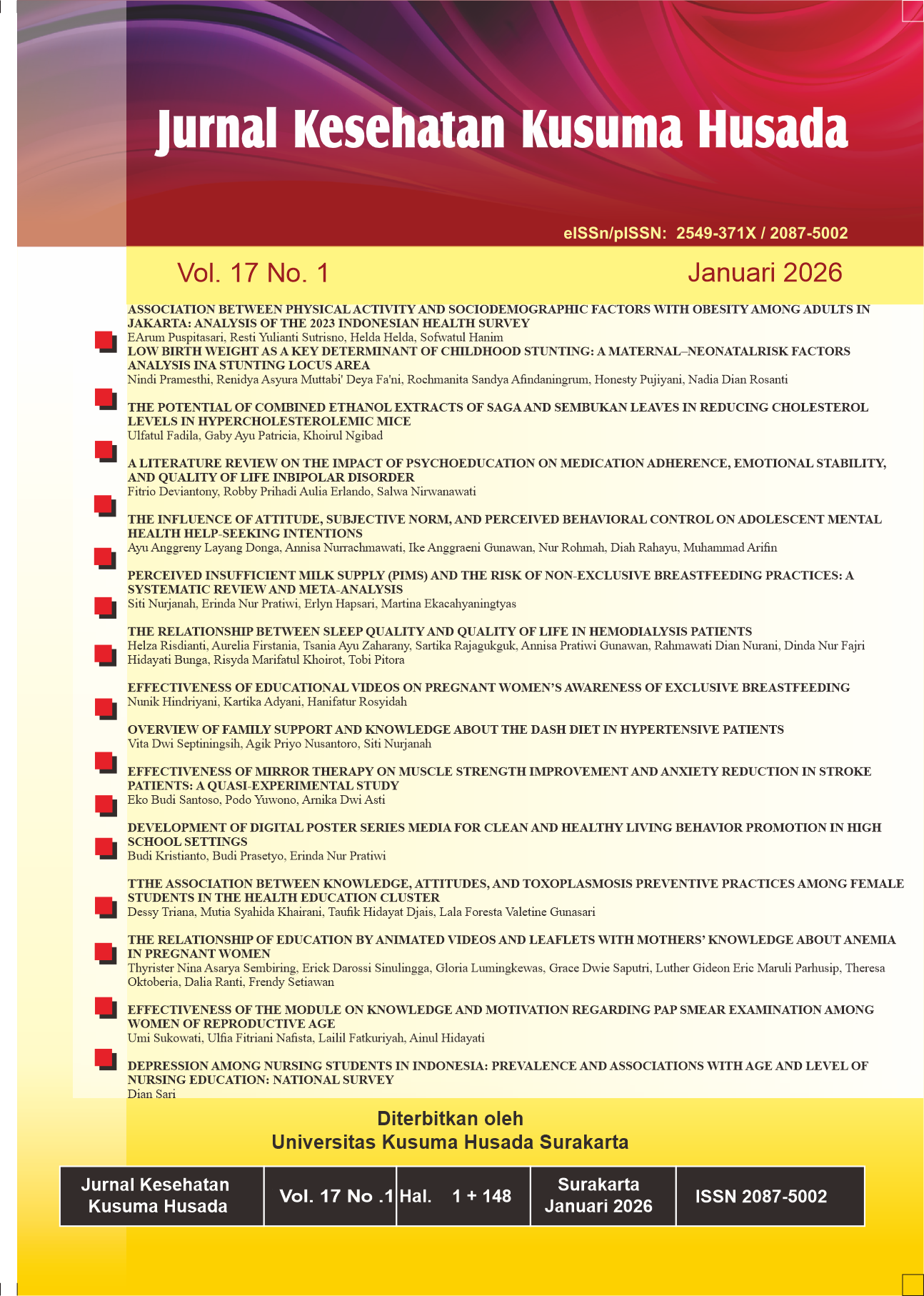
A LITERATURE REVIEW ON THE IMPACT OF PSYCHOEDUCATION ON MEDICATION ADHERENCE, EMOTIONAL STABILITY, AND QUALITY OF LIFE INBIPOLAR DISORDER
DOI:
https://doi.org/10.34035/jk.v17i1.1897Keywords:
bipolar disorder, non-pharmacological therapy, psychoeducationAbstract
Background: Bipolar disorder (BD) is a chronic psychiatric condition characterized by recurrent mood episodes that significantly impair psychosocial functioning and quality of life. Alongside pharmacological treatment, psychoeducation is recognized as an essential non-pharmacological intervention that enhances illness awareness, supports self-management, improves medication adherence, and facilitates early detection of relapse warning signs.
Aim: This literature review aims to examine the effectiveness of psychoeducational therapy in the management of bipolar disorder, focusing on relapse prevention, medication adherence, emotional stability, and quality of life.
Methods: A literature review was conducted using studies published between 2020 and 2024 and retrieved from Google Scholar and PubMed databases. The search utilized keywords such as “psychoeducational non-pharmacological therapy” and “bipolar disorder.” Included studies comprised randomized controlled trials, quasi-experimental studies, cohort studies, and systematic reviews.
Results: The findings indicate that psychoeducation plays a significant role in improving both clinical and psychosocial outcomes in individuals with BD. Psychoeducational interventions consistently reduced relapse rates, improved medication adherence, enhanced emotional stability, and strengthened patients’ and families’ coping abilities. Family-based and culturally adapted approaches further increased treatment engagement and reduced caregiver burden.
Conclusion: Psychoeducation is a vital adjunct to pharmacological treatment in bipolar disorder management, contributing to sustained symptom control and improved quality of life.
References
Arnbjerg, C. J., Musoni-Rwililiza, E., Rurangwa, N. U., Bendtsen, M. G., Murekatete, C., Gishoma, D., Carlsson, J., & Kallestrup, P. (2024). Effectiveness of structured group psychoeducation for people with bipolar disorder in Rwanda: A randomized open-label superiority trial. Journal of Affective Disorders, 356, 405–413. https://doi.org/10.1016/j.jad.2024.04.071
Bahrami, R., & Khalifi, T. (2022). The Effect of Psycho-education on the Affiliate Stigma in Family Caregivers of People with Bipolar Disorder. SAGE open nursing, 8, 23779608221132166. https://doi.org/10.1177/23779608221132166
Casellas, E., Raventós, B., Piñeiro-Ríos, M., Navarro-Martínez, H., Castillón-Espezel, M., Portella, M. J., & Martín-Blanco, A. (2021). A Real-World Study of the Association between a Brief Group Psychoeducation and the Course of Bipolar Disorder. International journal of environmental research and public health, 18(9), 5019. https://doi.org/10.3390/ijerph18095019
Ershad Sarabi R , Ebnehoseini Z, Sarafi Nejad A, Akbarzadeh F, Ziaee M, et al. The Investigation of the Effectiveness of Mobile-based Psychoeducation in Patients with Bipolar Disorder: A Randomized Controlled Trial (RCT). Shiraz E-Med J. 2021;22(7):e105674. https://doi.org/10.5812/semj.105674.
Fujika, K., Watanabe, N., Yamada, A., Katsuki, F., & Hasegawa, T. (2022). Effectiveness of psychoeducation for bipolar disorder: A systematic review and meta-analysis following PRISMA guidelines. BMC Psychiatry, 22(1), 1–14. https://doi.org/10.1186/s12888-022-03871-5
Gabriele, A., Sachs, G., Jagsch, R., Lenz, G., Erfurth, A., & Winkler, D. (2020). Effectiveness of cognitive psychoeducational group therapy in patients with bipolar disorder: A randomized controlled trial. International Journal of Bipolar Disorders, 8(1), 1–12. https://doi.org/10.1186/s40345-020-00192-3
Goes F. S. (2023). Diagnosis and management of bipolar disorders. BMJ (Clinical research ed.), 381, e073591. https://doi.org/10.1136/bmj-2022-073591
Husain, M. I., Umer, M., Asif, M., Khoso, A. B., Kiran, T., Ansari, M., Aslam, H., Bhatia, M. R., Dogar, F. A., Husain, M. O., Khan, H. A., Mufti, A. A., Mulsant, B. H., Naeem, F., Naqvi, H. A., de Oliviera, C., Siddiqui, M. S., Tamizuddin, A., Wang, W., Zaheer, J., … Chaudhry, I. B. (2022). Culturally adapted psychoeducation for bipolar disorder in a low-resource setting: protocol for a multicentre randomised controlled trial. BJPsych open, 8(6), e206. https://doi.org/10.1192/bjo.2022.598
Juliana, L., Cruz, B. F., Rodrigues Ferreira, J. D., Viana, B. M., & Barbosa, I. G. (2021). Psychoeducation in bipolar disorder: A systematic review. World Journal of Psychiatry, 11(12), 1407–1424. https://doi.org/10.5498/wjp.v11.i12.1407
Katsuki, F., Watanabe, N., Yamada, A., & Hasegawa, T. (2022). Effectiveness of family psychoeducation for major depressive disorder: systematic review and meta-analysis. BJPsych Open, 8(5), e148. https://doi:10.1192/bjo.2022.543
Kurniyawan, E. H., Dewi, E. I., Wuryaningsih, E. W., Deviantony, F., & Fitria, Y. (2023). The Effect of Self-Help Group (SHG) on Family's Ability in Treating Person with Mental Illness (PWMI). https://doi.org/10.53713/nhs.v3i1.173
Landry, S., & Provencher, M. D. (2020). Évaluation qualitative de l’implantation de groupes psychoéducatifs pour le trouble bipolaire à Québec [Qualitative Evaluation of the Implementation of Group Psychoeducation for Bipolar Disorder in Clinical Settings in Quebec]. Sante mentale au Quebec, 45(1), 31–52. https://doi.org/10.7202/1070240ar
Latifian, M., Raheb, G., Abdi, K., Alikhani, R., & Shariful Islam, S. M. (2022). The effectiveness of psychoeducation in improving attitudes towards psychological disorders and internalized stigma in the family members of bipolar patients: A quasi-experimental study. PsyCh journal, 12(2), 272–279. https://doi.org/10.1002/pchj.621
Luciano, M., Sampogna, G., Del Vecchio, V., Giallonardo, V., Di Cerbo, A., Palummo, C., Malangone, C., Lampis, D., Veltro, F., Bardicchia, F., Ciampini, G., Orlandi, E., Moroni, A., Biondi, S., Piselli, M., Menculini, G., Nicolò, G., Pompili, E., Carrà, G., & Fiorillo, A. (2022). Medium and long-term efficacy of psychoeducational family intervention for bipolar I disorder: Results from a real-world, multicentric study. Bipolar disorders, 24(6), 647–657. https://doi.org/10.1111/bdi.13182
Mario, M., Carta, M. G., Orrù, G., Littera, R., Firinu, D., Cossu, G., & Del Giacco, S. (2022). Real-world effectiveness of group psychoeducation on quality of life and emotional stability in bipolar disorder: A multicenter controlled study. Journal of Affective Disorders, 308, 45–53. https://doi.org/10.1016/j.jad.2022.04.067
Rabelo, J. L., Cruz, B. F., Ferreira, J. D. R., Viana, B. M., & Barbosa, I. G. (2021). Psychoeducation in bipolar disorder: A systematic review. World journal of psychiatry, 11(12), 1407–1424. https://doi.org/10.5498/wjp.v11.i12.1407
Raheleh, M., Hosseini, S. H., Mohammadi, N., & Ghasemi, R. (2022). The effects of psychoeducation on medication adherence and emotional regulation in patients with bipolar disorder: A quasi-experimental study. Iranian Journal of Psychiatry and Behavioral Sciences, 16(3), e123456. https://doi.org/10.5812/ijpbs.123456
Reinares, M., Pacchiarotti, I., Solé, B., García-Estela, A., Rosa, A. R., Bonnín, C. M., De Dios, C., Torres, I., Varo, C., Montejo, L., Valls, È., Mur-Mila, E., Hidalgo-Mazzei, D., Jiménez, E., Torrent, C., Goikolea, J. M., Martínez-Arán, A., Pérez- Sola, V., Vieta, E., & Colom, F. (2020). A prospective longitudinal study searching for predictors of response to group psychoeducation in bipolar disorder. Journal of affective disorders, 274, 1113–1121. https://doi.org/10.1016/j.jad.2020.02.047
Sachs, G., Berg, A., Jagsch, R., Lenz, G., & Erfurth, A. (2020). Predictors of Functional Outcome in Patients With Bipolar Disorder: Effects of Cognitive Psychoeducational Group Therapy After 12 Months. Frontiers in psychiatry, 11, 530026. https://doi.org/10.3389/fpsyt.2020.530026
Sarabi, Z., Shahini, N., Rezaei, F., & Ahmadi, M. (2021). The impact of psychoeducation on relapse prevention and medication adherence in bipolar disorder: A randomized controlled trial. Archives of Psychiatric Nursing, 35(6), 593–600. https://doi.org/10.1016/j.apnu.2021.09.003
Valls, È., Sánchez-Moreno, J., Bonnín, C. M., Solé, B., Prime-Tous, M., Torres, I., ... & Reinares, M. (2020). Effects of an integrative approach to bipolar disorders combining psychoeducation, mindfulness-based cognitive therapy and functional remediation: Study protocol for a randomized controlled trial. Revista de Psiquiatría y Salud Mental (English Edition), 13(3), 165-173. https://doi.org/10.1016/j.rpsm.2020.05.005
Van Den Berg, K. C., Hendrickson, A. T., Hales, S. A., Voncken, M., & Keijsers, G. P. J. (2023). Comparing the effectiveness of imagery focussed cognitive therapy to group psychoeducation for patients with bipolar disorder: a randomised trial. Journal of affective disorders, 320, 691-700. https://doi.org/10.1016/j.jad.2022.09.160
Zyto, S., Jabben, N., Schulte, P. F. J., Regeer, E. J., Goossens, P. J. J., Kupka, R. W., & Task Force Psychotherapy of the Dutch Foundation for Bipolar Disorders (2020). A multi-center naturalistic study of a newly designed 12-sessions group psychoeducation program for patients with bipolar disorder and their caregivers. International journal of bipolar disorders, 8(1), 26. https://doi.org/10.1186/s40345-020-00190-5
Downloads
Published
Issue
Section
License
Copyright (c) 2026 Jurnal Kesehatan Kusuma Husada

This work is licensed under a Creative Commons Attribution 4.0 International License.
The copyright of the published articles belongs to Jurnal Kesehatan Kusuma Husada.

This work is licensed under a Creative Commons Attribution 4.0 International License.