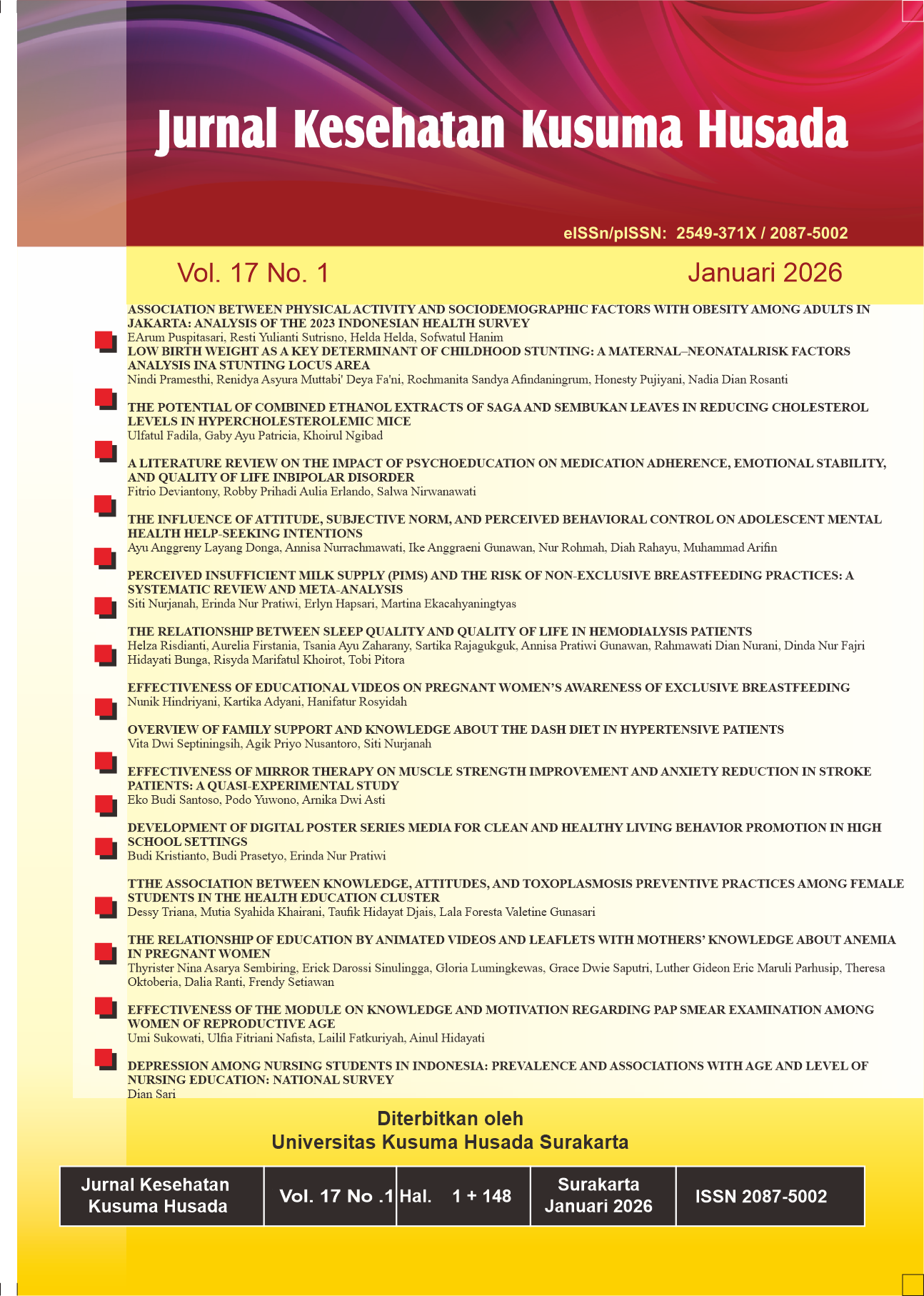
THE ASSOCIATION BETWEEN KNOWLEDGE, ATTITUDES, AND TOXOPLASMOSIS PREVENTIVE PRACTICES AMONG FEMALE STUDENTS IN THE HEALTH EDUCATION CLUSTER
DOI:
https://doi.org/10.34035/jk.v17i1.1910Keywords:
attitude, knowledge, practices, prevention, toxoplasmosisAbstract
Background: Toxoplasmosis is an infectious disease resulting from exposure to the parasite Toxoplasma gondii. The prevalence of toxoplasmosis among women of reproductive age in Indonesia remains significant, attributed to factors such as individual behaviours, inadequate hygiene practices, and cultural traditions. Moreover, the prevalence of toxoplasmosis is elevated among populations with limited awareness of preventive measures, highlighting the importance of comprehensive education to decrease its incidence, particularly among women of reproductive age. Strengthening their comprehension, attitudes, and preventive behaviors is crucial as an initial strategy to reduce toxoplasmosis transmission. This study aimed to examine the association between knowledge, attitudes, and preventive practices regarding toxoplasmosis among female health education students at the University of Bengkulu.
Methods: This study employed an observational, cross-sectional design. The research population comprised 925 individuals, from which 70 female students in the health education cluster at the University of Bengkulu were selected as study subjects through stratified random sampling. Data were gathered via questionnaires and analyzed using the Spearman rank correlation test.
Results: The data indicated that 41 respondents (58.6%) demonstrated a high level of knowledge, 55 respondents (78.6%) maintained positive attitudes, and 59 respondents (84.3%) practiced effective preventive practices regarding toxoplasmosis. Statistical analysis revealed a significant association between knowledge level and preventive practices (p-value <0.001, r = 0.565), as well as between attitude and preventive practices (p-value <0.001, r = 0.705).
Conclusion: A significant association exists between knowledge levels and attitudes regarding toxoplasmosis prevention practices.
References
Afina, N.M. and Mediana, D. (2022). Knowledge Level Was Not Related To Toxoplasmosis Preventive Behavior In Childbearing-Age Women. Journal Biomedika dan Kesehatan, 5(2), pp. 69–74. https://doi.org/10.18051/JBiomedKes.2022.v5.69-74.
Aldali, J.A. et al. (2024). Assessment of Knowledge, Attitude, and Preventive Behavior Regarding Toxoplasmosis among Females in Riyadh, Saudi Arabia: A Cross-Sectional Study. International Journal of Environmental Research and Public Health, 21(8), p. 1065–1068. https://doi.org/10.3390/ijerph21081065.
Alghafari, W.T. (2025). Toxoplasmosis Knowledge and Preventive Behaviours Among Pregnant Women in Jeddah, Saudi Arabia: A Cross-Sectional Study. Healthcare, 13(2), p. 174–180. https://doi.org/10.3390/healthcare13020174.
Al-Sheyab, N.A. et al. (2015). Toxoplasmosis-Related Knowledge and Preventive Practices among Undergraduate Female Students in Jordan. Journal of Food Protection, 78(6), pp. 1161–1166. https://doi.org/10.4315/0362-028X.JFP-14-579.
Anggreni, NMO, Kurniati, DPY, and Subrata, IM (2019). Hubungan Tingkat Pengetahuan dan Sikap Ibu Hamil terhadap Perilaku Pencegahan Toksoplasmosis di Wilayah Kerja Puskesmas Blahbatuh I Tahun 2017. Archive Of Community Health, 6(1), pp 34–39. https://doi.org/10.24843/ACH.2019.v06.i01.p05.
Arikunto, S. (2013). Research Procedures: A Practical Approach. 4th edn. Jakarta: Rineka Cipta.
Aryani, I. (2017). Congenital Toxoplasmosis. Continuing Medical Education. 44(8). pp 1–3. Available at: https://www.orpha.net/data/patho/GB/uk-toxo.pdf.
CDC (2025) Toxoplasmosis: Cause and How it Spreads. Available at: https://www.cdc.gov/toxoplasmosis/causes/index.html (Accessed: 2 January 2025).
Bengkulu Provincial Health Office (2023). Government Agency Performance Accountability Report (LAKIP). Bengkulu.
Green, L. et al. (2022). Health Program Planning, Implementation, and Evaluation. 2nd edn. Edited by J. Ottoson. Johns Hopkins University Press.
Guo, Y.L. et al. (2017). Infection status of Toxoplasma gondii and its related knowledge and behavior among the special population in Changzhou City. Chinese Journal of Schistosomiasis Control, 29(4), pp. 498–501. https://doi.org/10.16250/J.32.1374.2016273.
Hilmi, IZ et al. (2023). Hubungan Tingkat Pengetahuan dengan Tindakan Pencegahan Toxoplasmosis Pada Pemelihara Kucing Di Kecamatan Medan Kota. Jurnal Implementa Husada, 4, pp. 57–62. https://doi.org/10.30596/jih.v4i1.13554.
Jastika, FR (2018). The Relationship between Knowledge Level and Attitude with Dengue Hemorrhagic Fever (DHF) Prevention Behavior among Cadres in Malang City. Thesis. Brawijaya University.
Kurniawan, B., Suwandi, JF, and Arniamantha, D. (2020). Perbedaan Tingkat Pengetahuan Dan Sikap Ibu Hamil Tentang Toksoplasmosis . Jurnal Online Unja, 8, pp 1–7. https://doi.org/10.22437/jmj.v8i1.9487.
Lilis, ZF et al. (2023). Parasitology (Helmintology and Protozoology ). 1st edn. Edited by Z. Fadilla. Aceh: Muhammad Zaini Publishing Foundation. Available at: http://penerbitzaini.com.
Mahfouz, M. et al. (2019). Knowledge and Attitude Regarding Toxoplasmosis Among Jazan University Female Students. Saudi Journal of Medicine and Medical Sciences, 7(1), p. 28. https://doi.org/10.4103/sjmms.sjmms_33_17.
Notoatmodjo, S. (2014). Health Behavior Science. 2nd edn. Jakarta: RinekaCipta.
Nurseha, F.T. et al. (2023). Knowledge, Attitudes, and Behavior to Prevent Transmission of Toxoplasma gondii among Cat Owners. Al-Sihah: The Public Health Science Journal, pp. 23–32. Available at: https://doi.org/10.24252/al-sihah.v15i1.36773.
Perdana, T.M. et al. (2025). Seroprevalence of anti-Toxoplasma IgG among the human population in Indonesia: a systematic review and meta-analysis. BMC Public Health, 25(1), p. 194. https://doi.org/10.1186/s12889-025-21317-2.
Polanunu, N.F.A., Wahyuni, S. & Hamid, F. (2021). Seroprevalence and associated risk factors of Toxoplasma gondii infection among pregnant mothers in Makassar, Indonesia, PLOS ONE, 16(6), pp. 1–6. https://doi.org/10.1371/journal.pone.0245572.
Pramardika , DD et al. (2022). Studi Literatur: Analisis Faktor Risiko Toxoplasmosis pada Wanita Indonesia. Jurnal Poltekkes Kemenkes Tasikmalaya, 15–25.
Rahmanian, V. et al. (2020). Seroprevalence Of Toxoplasma Gondii Infection: An Umbrella Review Of Updated Systematic Reviews And Meta-Analyses. Journal of Family Medicine and Primary Care, 9(8), pp. 3848–3855. https://doi.org/10.4103/jfmpc.jfmpc_753_20.
Senosy, S.A. (2022). Knowledge And Attitudes About Toxoplasmosis Among Female University Students In Egypt. International Journal of Adolescent Medicine and Health, 34(3), pp. 2–7. https://doi.org/10.1515/ijamh-2019-0207.
Smereka, J. et al. (2018). A Multicenter Survey On Toxoplasmosis Knowledge Among Pregnant Women In Poland (the TOWER study). BMC Pregnancy and Childbirth, 18(1), p. 389. https://doi.org/10.1186/s12884-018-2031-7.
Swandi, K. et al. (2024). The Relationship between Knowledge and Preventive Actions against Toxoplasmosis in Students of the Faculty of Medicine, UNAND. Indonesian Journal of Health Sciences, 5(1), pp 1–8. https://doi.org/10.25077/jikesi.v5i1.1058.
Sweileh, W.M. & Jodeh, D.S. (2017). Toxoplasmosis-Related Knowledge and Preventive Practices among Undergraduate Female Students. IUG Journal of Natural Studies, Peer-reviewed Journal of Islamic-Gaza, 25(3), pp. 45–52.
Yani, WP et al. (2022). Level of Knowledge and Attitude About Toxoplasmosis in Students/I Biology Study Program UIN Syarif Hidayatullah Jakarta, 2, pp 1–11. Available at: https://doi.org/10.24036/prosemnasbio/vol2/399.
Downloads
Published
Issue
Section
License
Copyright (c) 2026 Jurnal Kesehatan Kusuma Husada

This work is licensed under a Creative Commons Attribution 4.0 International License.
The copyright of the published articles belongs to Jurnal Kesehatan Kusuma Husada.

This work is licensed under a Creative Commons Attribution 4.0 International License.