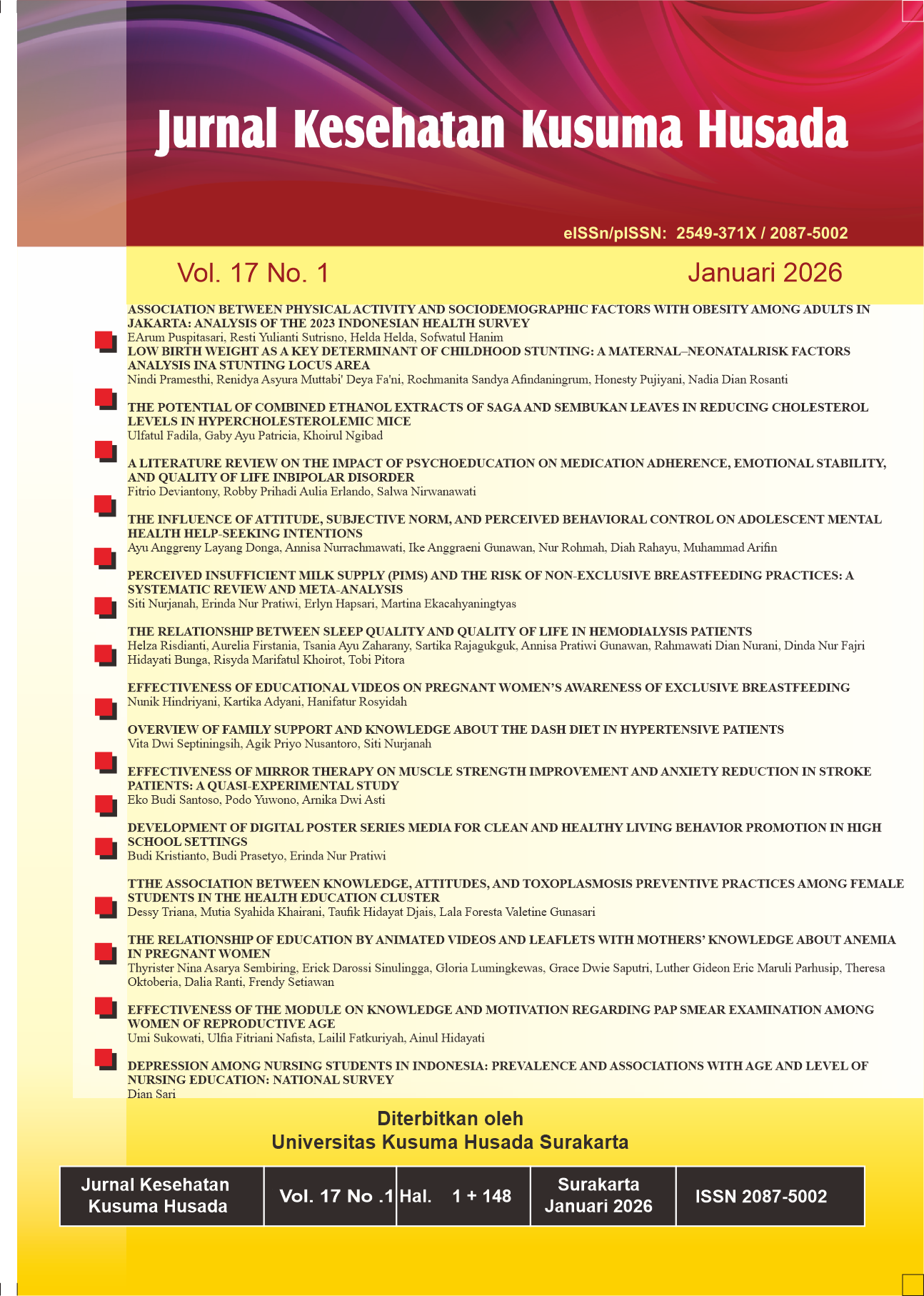
LOW BIRTH WEIGHT AS A KEY DETERMINANT OF CHILDHOOD STUNTING: A MATERNAL–NEONATALRISK FACTORS ANALYSIS INA STUNTING LOCUS AREA
DOI:
https://doi.org/10.34035/jk.v17i1.1930Keywords:
low birth weight, neonatal factors, stuntingAbstract
Background: Many studies have examined the effects of inadequate nutritional intake, showing an increased risk of infectious diseases, death, and obstacles to children's growth and development. According to the results of SSGI 2024, the prevalence of stunting among children under five was 19.8%; this figure remains far from the medium-term national target. This research aims to determine the determinants of stunting in a stunting-affected area.
Methods: A quantitative analytical study with a case-control approach was used in this study. The research was conducted in Buker Village, one of the stunting loci in Sampang Regency. The research subjects consisted of 35 stunted toddlers in the case group and 40 toddlers with normal nutritional status in the control group. Data analysis in this study included univariate analysis using frequency distributions, bivariate analysis using the chi-square test, and multivariate analysis using multiple logistic regression.
Results: The results showed that the most dominant factor associated with stunting was a history of low birth weight (LBW) OR 24,1 (95% CI: 2,573 – 226,647), which means that toddlers who were born with LBW had a 24,1 times higher chance of stunting.
Conclusion: This study identifies low birth weight as a key determinant of stunting, as affected infants face developmental vulnerabilities. Strengthening maternal nutrition, infection prevention, and postnatal growth monitoring is essential to mitigate long-term growth deficits. These findings emphasize the importance of integrating maternal nutrition programs with neonatal monitoring, particularly in high-burden settings, to effectively improve child growth outcomes.
References
Afian, D. H., Anam, M. S., Himawan, A. B., & Suswihardhyono, A. N. R. (2021). Faktor yang Berhubungan dengan Kenaikan Berat Badan Bayi Berat Lahir Rendah. Sari Pediatri, 23(2). https://doi.org/10.14238/sp23.2.2021.75-81
Apriluana, G., & Fikawati, S. (2018). Analisis Faktor-Faktor Risiko terhadap Kejadian Stunting pada Balita (0-59 Bulan) di Negara Berkembang dan Asia Tenggara. Media Penelitian Dan Pengembangan Kesehatan, 28(4). https://doi.org/10.22435/mpk.v28i4.472
Arabzadeh, H., Doosti-Irani, A., Kamkari, S., Farhadian, M., Elyasi, E., & Mohammadi, Y. (2024). The maternal factors associated with infant low birth weight: an umbrella review. BMC Pregnancy and Childbirth, 24(1). https://doi.org/10.1186/s12884-024-06487-y
Budge, S., Parker, A. H., Hutchings, P. T., & Garbutt, C. (2019). Environmental enteric dysfunction and child stunting. In Nutrition Reviews (Vol. 77, Issue 4). https://doi.org/10.1093/nutrit/nuy068
Dinas KOMINFO Jatim. (2025). Prevalensi Stunting Jatim Terbaik di Pulau Jawa. https://kominfo.jatimprov.go.id/berita/prevalensi-stunting-jatim-terbaik-di-pulau-jawa
Gabain, I. L., Ramsteijn, A. S., & Webster, J. P. (2023). Parasites and childhood stunting – a mechanistic interplay with nutrition, anaemia, gut health, microbiota, and epigenetics. In Trends in Parasitology (Vol. 39, Issue 3). https://doi.org/10.1016/j.pt.2022.12.004
Grillo, M. A., Mariani, G., & Ferraris, J. R. (2022). Prematurity and Low Birth Weight in Neonates as a Risk Factor for Obesity, Hypertension, and Chronic Kidney Disease in Pediatric and Adult Age. In Frontiers in Medicine (Vol. 8). https://doi.org/10.3389/fmed.2021.769734
Halimatunisa, F., & Ikhssani, A. (2022). Stunting pada Anak dan Faktor Risiko Infeksi. Jurnal Stunting Pesisir Dan Aplikasinya, 1(1). https://doi.org/10.36990/jspa.v1i1.437
Hartantio, F. W., Triagung, B., Prabantoro, R., & Wijono, S. (2023). The Correlation Between Low Birth Weight And Stunting In 2-5 Years OldCHILDREN. Journal of Widya Medika Junior, 5(1). https://doi.org/10.1186/s12889-016-3339-8
Hossain, S., & Mihrshahi, S. (2022). Exclusive Breastfeeding and Childhood Morbidity: A Narrative Review. In International Journal of Environmental Research and Public Health (Vol. 19, Issue 22). https://doi.org/10.3390/ijerph192214804
Huang, C., Jiang, Q., Su, W., Lv, F., Zeng, J., Huang, P., Liu, W., Lin, M., Li, X., Shi, X., & Zheng, X. (2023). Age-specific effects on adverse pregnancy outcomes vary by maternal characteristics: a population-based retrospective study in Xiamen, China. BMC Public Health, 23(1). https://doi.org/10.1186/s12889-023-15235-4
Kemenkes. (2025). SSGI 2024: Prevalensi Stunting Nasional Turun Menjadi 19,8%. https://kemkes.go.id/id/ssgi-2024-prevalensi-stunting-nasional-turun-menjadi-198
Laksono, A. D., Wulandari, R. D., Amaliah, N., & Wisnuwardani, R. W. (2022). Stunting among children under two years in Indonesia: Does maternal education matter? PLoS ONE, 17(7 July). https://doi.org/10.1371/journal.pone.0271509
Ogawa, K., Matsushima, S., Urayama, K. Y., Kikuchi, N., Nakamura, N., Tanigaki, S., Sago, H., Satoh, S., Saito, S., & Morisaki, N. (2019). Association between adolescent pregnancy and adverse birth outcomes, a multicenter cross sectional Japanese study. Scientific Reports, 9(1). https://doi.org/10.1038/s41598-019-38999-5
Okwaraji, Y. B., Krasevec, J., Bradley, E., Conkle, J., Stevens, G. A., Gatica-Domínguez, G., Ohuma, E. O., Coffey, C., Estevez Fernandez, D. G., Blencowe, H., Kimathi, B., Moller, A. B., Lewin, A., Hussain-Alkhateeb, L., Dalmiya, N., Lawn, J. E., Borghi, E., & Hayashi, C. (2024). National, regional, and global estimates of low birthweight in 2020, with trends from 2000: a systematic analysis. The Lancet, 403(10431). https://doi.org/10.1016/S0140-6736(23)01198-4
Özdemir, Ö. (2020). Primary Immunodeficiency Diseases in the Newborn. Northern Clinics of Istanbul. https://doi.org/10.14744/nci.2020.43420
Rahmawati Hamzah, S., & Khairun Nisa Mokodompit, K. (2022). Riwayat Berat Badan Lahir Rendah Dengan Kejadian Stunting Pada Anak Usia Dibawah Dua Tahun Di Kotamobagu. MADANI: Jurnal Ilmiah Multidisiplin, 2(2), 44–51. https://doi.org/10.52022/jikm.v17i1.744
Rauf, F. H., Winarti, E., Haryuni, S., & Alimansur, M. (2024). Faktor – Faktor Yang Mempengaruhi Kejadian Stunting Di Puskesmas Wayabula Kecamatan Morotai Selatan Barat Tahun 2023. Jurnal Ilmu Kesehatan, 12(2). https://doi.org/10.32831/jik.v12i2.678
Robert M. Kliegman & Joseph St. Geme. (2020). [#24076] Nelson Textbook of Pediatrics 2-Volume Set, 21st Edition. 19 Apr 2019.
Sangkhae, V., Fisher, A. L., Ganz, T., & Nemeth, E. (2023). Iron Homeostasis during Pregnancy: Maternal, Placental, and Fetal Regulatory Mechanisms. In Annual Review of Nutrition (Vol. 43). https://doi.org/10.1146/annurev-nutr-061021-030404
Susanti, Y. E., Kirana, R., & Laili, F. J. (2024). Hubungan Ibu KEK dan IBU Anemia dengan Kejadian Stunting pada Balita di Wilayah Kerja Puskesmas Batulicin Kabupaten Tanah Bumbu Tahun 2024. Integrative Perspectives of Social and Science Journal, 2(1), 254–264.
World Health Organization. (2019). WHO guideline on use of ferritin concentrations to assess iron status in individuals and populations. In Sustainability (Switzerland) (Vol. 11, Issue 1)
Downloads
Published
Issue
Section
License
Copyright (c) 2026 Jurnal Kesehatan Kusuma Husada

This work is licensed under a Creative Commons Attribution 4.0 International License.
The copyright of the published articles belongs to Jurnal Kesehatan Kusuma Husada.

This work is licensed under a Creative Commons Attribution 4.0 International License.