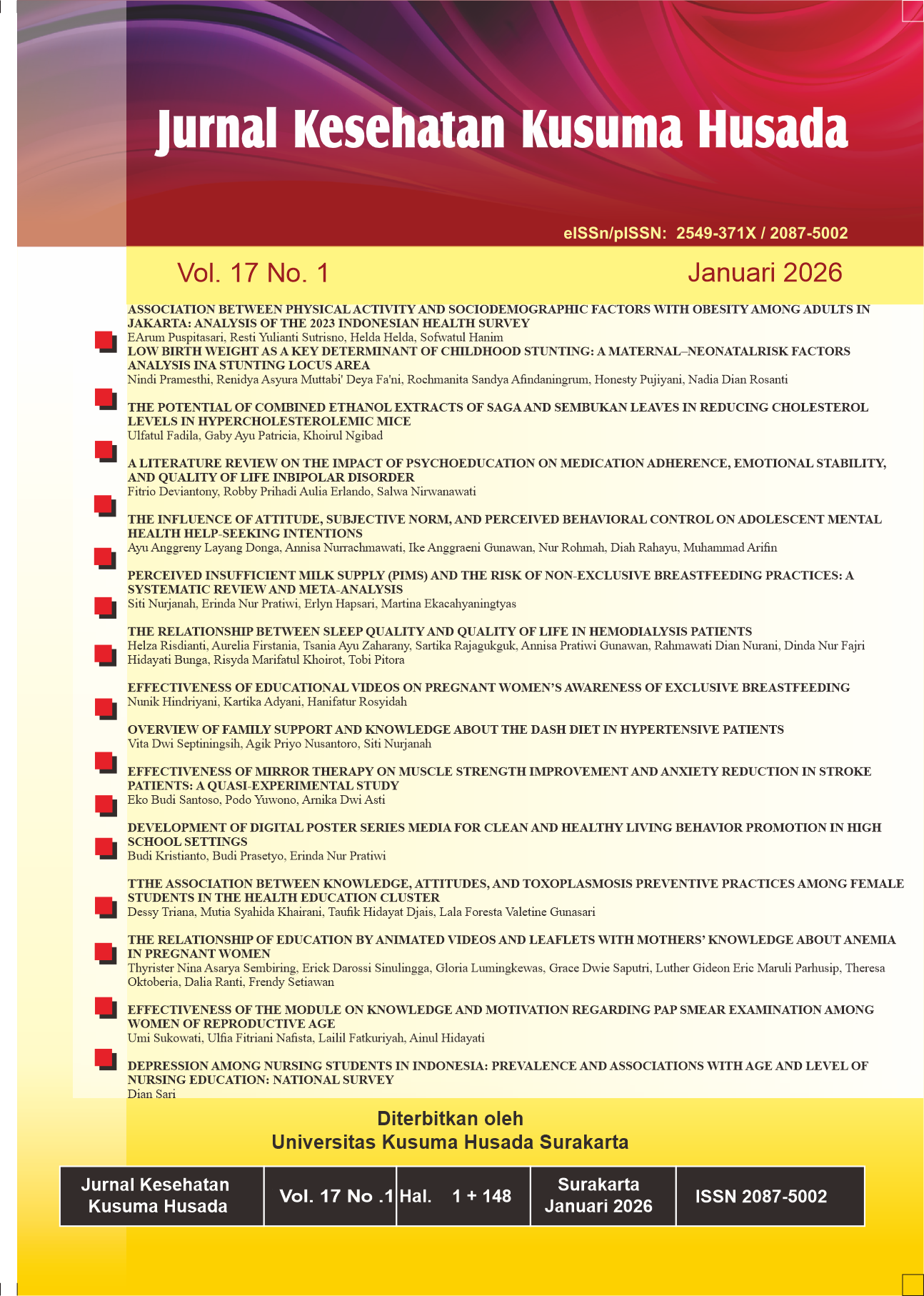
PERCEIVED INSUFFICIENT MILK SUPPLY (PIMS) AND THE RISK OF NON-EXCLUSIVE BREASTFEEDING PRACTICES: A SYSTEMATIC REVIEW AND META-ANALYSIS
DOI:
https://doi.org/10.34035/jk.v17i1.1933Keywords:
breastfeeding practices, maternal perception, meta-analysis, Perceived insufficient milk supply (PIMS), systematic reviewAbstract
Background: PIMS, or what is usually called insufficient breast milk supply, is one of the reasons why breastfeeding fails. There are still a few mothers who know about the perception of insufficient breast milk supply and how this has an impact on breastfeeding practices. This study aimed to examine the association between perceived insufficient milk supply (PIMS) and the risk of non-exclusive breastfeeding during the first six months postpartum.
Methods: This review was conducted following the PRISMA guidelines to select articles in this study and based on PICO (Population, Intervention, Comparison, Outcome). We searched for relevant articles in five databases, such as PubMed, ScienceDirect, Springer Link, ProQuest, and SAGE journals, from January 2014 to August 2024. Then, they carried out a meta-analysis of the collected data and analyzed the Odds Ratio (OR) using Review Manager 5.3. Overall, 6 studies were appropriate in this review.
Results: Six studies were included in the meta-analysis. The forest plot demonstrated a consistent inverse association between perceived insufficient milk supply (PIMS) and exclusive breastfeeding across all included studies. Using a random-effects model, mothers with PIMS had significantly lower odds of exclusive breastfeeding during the first six months postpartum (pooled OR = 0.10; 95% CI: 0.04–0.24; p < 0.00001), indicating a substantially increased risk of non-exclusive breastfeeding.
Conclusion: Perceived insufficient milk supply (PIMS) has a relationship with the incidence of failure to provide exclusive breastfeeding.
References
Agampodi, T. C., Dharmasoma, N. K., Koralagedara, I. S., Dissanayaka, T., Warnasekara, J., Agampodi, S. B., & Perez-Escamilla, R. (2021). Barriers for early initiation and exclusive breastfeeding up to six months in predominantly rural Sri Lanka: a need to strengthen policy implementation. International Breastfeeding Journal, 16(1), 1–12. https://doi.org/10.1186/S13006-021-00378-0/FIGURES/1
Brown, C. R. L., Dodds, L., Legge, A., Bryanton, J., & Semenic, S. (2014). Factors influencing the reasons why mothers stop breastfeeding. Canadian Journal of Public Health, 105(3), e179–e185. https://doi.org/10.17269/CJPH.105.4244/METRICS
Budiati, T., & Setyowati. (2019). The influence of culture and maternal care on exclusive breastfeeding practice in post-caesarean section mothers. Enfermería Clínica, 29, 808–814. https://doi.org/10.1016/J.ENFCLI.2019.04.121
Chang, P.-C., Li, S.-F., Yang, H.-Y., Wang, L.-C., Weng, C.-Y., Chen, K.-F., Chen, W., & Fan, S.-Y. (2019). Factors associated with cessation of exclusive breastfeeding at 1 and 2 months postpartum in Taiwan. International Breastfeeding Journal, 14(18), 1–7. https://doi.org/10.1186/s13006-019-0213-1
Chantry, C. J., Dewey, K. G., Peerson, J. M., Wagner, E. A., & Nommsen-Rivers, L. A. (2014). In-hospital formula use increases early breastfeeding cessation among first-time mothers intending to exclusively breastfeed. The Journal of Pediatrics, 164(6). https://doi.org/10.1016/J.JPEDS.2013.12.035
Choo, P. J., & Ryan, K. (2016). A qualitative study exploring first-time mothers’ experiences of breastfeeding in Singapore. Proceedings of Singapore Healthcare, 25(1), 5–12. https://doi.org/10.1177/2010105815615992
Chowdhury, R., Sinha, B., Sankar, M. J., Taneja, S., Bhandari, N., Rollins, N., Bahl, R., & Martines, J. (2015). Breastfeeding and maternal health outcomes: a systematic review and meta-analysis. Acta Paediatrica, 104, 96–113. https://doi.org/10.1111/APA.13102
Dashti, M., Scott, J. A., Edwards, C. A., & Al-Sughayer, M. (2014). Predictors of Breastfeeding Duration among Women in Kuwait: Results of a Prospective Cohort Study. Nutrients 2014, Vol. 6, Pages 711-728, 6(2), 711–728. https://doi.org/10.3390/NU6020711
De Roza, M. J. G., Fong, M. M. K., Ang, M. B. L., Sadon, M. R. B., Koh, M. E. Y. L., & Teo, M. S. S. H. (2019). Exclusive breastfeeding, breastfeeding self-efficacy, and perception of milk supply among mothers in Singapore: A longitudinal study. Midwifery, 79, 102532. https://doi.org/10.1016/J.MIDW.2019.102532
Demirci, J. R., & Bogen, D. L. (2017). An Ecological Momentary Assessment of Primiparous Women’s Breastfeeding Behavior and Problems From Birth to 8 Weeks. Journal of Human Lactation : Official Journal of International Lactation Consultant Association, 33(2), 285–295. https://doi.org/10.1177/0890334417695206
Dinas Kesehatan Kota Surakarta. (2023). Profil Kesehatan Kota Surakarta 2023 Dinas Kesehatan Kota Surakarta. 1–207. www.dinkes.surakarta.go.id
Fu, C.-Y., Tang, X.-J., Pan, L.-P., Jin, H.-Y., Yao, J.-F., & Wang, L.-Z. (2021). Exclusive breastfeeding rate and related factors among mothers within maternal health WeChat groups in Jiaxing, Zhejiang province, China: a cross-sectional survey. International Breastfeeding Journal, 17, 80. https://doi.org/10.1186/s13006-022-00521-5
Gianni, M. L., Bettinelli, M. E., Manfra, P., Sorrentino, G., Bezze, E., Plevani, L., Cavallaro, G., Raffaeli, G., Crippa, B. L., Colombo, L., Morniroli, D., Liotto, N., Roggero, P., Villamor, E., Marchisio, P., & Mosca, F. (2019). Breastfeeding Difficulties and Risk for Early Breastfeeding Cessation. Nutrients, 11(10). https://doi.org/10.3390/NU11102266
Kasahun, A. W., Wako, W. G., Gebere, M. W., & Neima, G. H. (2017). Predictors of exclusive breastfeeding duration among 6-12-month-old children in Gurage Zone, South Ethiopia: A survival analysis. International Breastfeeding Journal, 12(1), 1–9. https://doi.org/10.1186/S13006-017-0107-Z/TABLES/3
Kent, J. C., Ashton, E., Hardwick, C. M., Rea, A., Murray, K., & Geddes, D. T. (2021). Causes of perception of insufficient milk supply in Western Australian mothers. Maternal and Child Nutrition, 17(1), 1–11. https://doi.org/10.1111/mcn.13080
Kera, A. M., Zewdie, A., Akafu, W., Radiet Kidane, |, & Meseret Tamirat, |. (2023). Formula feeding and associated factors among mothers with infants 0-6 months old in Mettu Town, Southwest Ethiopia. https://doi.org/10.1002/fsn3.3403
Lagie Babakazo Id, P., Bosonkie, M., Mafuta, E., Mvuama Id, N., & Mapatano, M.-A. (2022). Common breastfeeding problems experienced by lactating mothers during the first six months in Kinshasa. https://doi.org/10.1371/journal.pone.0275477
Lou, Z., Zeng, G., Huang, L., Wang, Y., Zhou, L., & Kavanagh, K. F. (2014). Maternal Reported Indicators and Causes of Insufficient Milk Supply. Http://Dx.Doi.Org/10.1177/0890334414542685, 30(4), 466–473. https://doi.org/10.1177/0890334414542685
Magarey, A., Kavian, F., Scott, J. A., Markow, K., & Daniels, L. (2016). Feeding Mode of Australian Infants in the First 12 Months of Life. Journal of Human Lactation : Official Journal of International Lactation Consultant Association, 32(4), NP95–NP104. https://doi.org/10.1177/0890334415605835
McGuire, T. M. (2018). Drugs affecting milk supply during lactation. Australian Prescriber, 41(1), 7. https://doi.org/10.18773/AUSTPRESCR.2018.002
Namyalo, H., Nankumbi, J., & Ngabirano, T. D. (2023). Perceived breast milk insufficiency: Prevalence and associated factors among women attending a young child clinic in Uganda. International Journal of Africa Nursing Sciences, 19, 100637. https://doi.org/10.1016/J.IJANS.2023.100637
Paramashanti, B. A., Dibley, M. J., Huda, T. M., & Alam, A. (2022). Breastfeeding perceptions and exclusive breastfeeding practices: A qualitative comparative study in rural and urban Central Java, Indonesia. Appetite, 170, 105907. https://doi.org/10.1016/J.APPET.2021.105907
Peacock-Chambers, E., Dicks, K., Sarathy, L., Brown, A. A., & Boynton-Jarrett, R. (2017). Perceived Maternal Behavioral Control, Infant Behavior, and Milk Supply: A Qualitative Study. Journal of Developmental and Behavioral Pediatrics : JDBP, 38(6), 401–408. https://doi.org/10.1097/DBP.0000000000000455
Piccolo, O., Kinshella, M. L. W., Salimu, S., Vidler, M., Banda, M., Dube, Q., Kawaza, K., Goldfarb, D. M., & Nyondo-Mipando, A. L. (2022). Healthcare worker perspectives on mothers’ insufficient milk supply in Malawi. International Breastfeeding Journal, 17(1), 1–9. https://doi.org/10.1186/s13006-022-00460-1
Quinn, E. A., Sobonya, S., & Palmquist, A. E. L. (2023). Maternal perceptions of human milk expression output: An experimental design using photographs of milk. Social Science & Medicine, 324, 115871. https://doi.org/10.1016/J.SOCSCIMED.2023.115871
Robert, E., Coppieters, Y., Swennen, B., & Dramaix, M. (2014a). The Reasons for early weaning, perceived insufficient breast milk, and maternal dissatisfaction: Comparative studies in two Belgian regions. ISRN Obstetrics and Gynecology, 2014. https://doi.org/10.1155/2014/678564
Robert, E., Coppieters, Y., Swennen, B., & Dramaix, M. (2014b). The Reasons for Early Weaning, Perceived Insufficient Breast Milk, and Maternal Dissatisfaction: Comparative Studies in Two Belgian Regions. International Scholarly Research Notices, 2014. https://doi.org/10.1155/2014/678564
Rodrigo, R., Rodrigo, A., Liyanage, N., Hatahagoda, W., & Hewavitharana, U. (2019). Maternal Perception of Adequacy of Mother’s Milk Among Mothers Giving Birth at a Teaching Hospital in Sri Lanka. Journal of Human Lactation : Official Journal of International Lactation Consultant Association, 35(1), 171–180. https://doi.org/10.1177/0890334418773304
Rozensztrauch, A., Klaniewska, M., & Berghausen-Mazur, M. (2022). Factors affecting the mother’s choice of infant feeding method in Poland: a cross-sectional preliminary study. Irish Journal of Medical Science, 191(4), 1735–1743. https://doi.org/10.1007/S11845-021-02751-8/TABLES/7
Saddki, N., Mohamad, N., Johar, N., Alina, T., Ismail, T., & Sulaiman, Z. (2022). Determinants of non-exclusive breastfeeding practice during the first 6 months after an elective caesarean birth: a prospective cohort study. International Breastfeeding Journal, 17, 36. https://doi.org/10.1186/s13006-022-00475-8
Safon, C., Keene, D., Guevara, W. J. U., Kiani, S., Herkert, D., Muñoz, E. E., & Pérez-Escamilla, R. (2017). Determinants of perceived insufficient milk among new mothers in León, Nicaragua. Maternal & Child Nutrition, 13(3). https://doi.org/10.1111/MCN.12369
Said Hassan, M., & Moyazzem Hossain, M. (2023). Challenges for influencing exclusive breastfeeding practice among lactating mothers with infants aged 0-6 months in Borama District, Somaliland: A cross-sectional study. Health Science Reports, 6. https://doi.org/10.1002/hsr2.1693
Sandhi, A., Lee, G. T., Chipojola, R., Huda, M. H., & Kuo, S. Y. (2020). The relationship between perceived milk supply and exclusive breastfeeding during the first six months postpartum: a cross-sectional study. International Breastfeeding Journal, 15(1), 1–11. https://doi.org/10.1186/s13006-020-00310-y
Stuebe, A. M., Horton, B. J., Chetwynd, E., Watkins, S., Grewen, K., & Meltzer-Brody, S. (2014). Prevalence and Risk Factors for Early, Undesired Weaning Attributed to Lactation Dysfunction. Https://Home.Liebertpub.Com/Jwh, 23(5), 404–412. https://doi.org/10.1089/JWH.2013.4506
Sun, K., Chen, M., Yin, Y., Wu, L., & Gao, L. (2017). Why Chinese mothers stop breastfeeding: Mothers’ self-reported reasons for stopping during the first six months. Journal of Child Health Care, 21(3), 353–363. https://doi.org/10.1177/1367493517719160/ASSET/IMAGES/LARGE/10.1177_1367493517719160-FIG1.JPEG
Thomas, J. (2016). Barriers to Exclusive Breastfeeding Among Mothers During the First Four Weeks Postpartum. Walden Dissertations and Doctoral Studies. https://scholarworks.waldenu.edu/dissertations/2197
WHO. (2014). Global nutrition targets 2025: breastfeeding policy brief. https://apps.who.int/iris/handle/10665/149022
WHO. Global nutrition targets 2025: breastfeeding policy brief 2014. https://apps.who.int/iris/handle/10665/149022 (accessed March 18, 2022)
Chowdhury R, Sinha B, Sankar MJ, Taneja S, Bhandari N, Rollins N, et al. Breastfeeding and maternal health outcomes: a systematic review and meta-analysis. Acta Paediatr 2015;104:96–113. https://doi.org/10.1111/APA.13102
Downloads
Published
Issue
Section
License
Copyright (c) 2026 Jurnal Kesehatan Kusuma Husada

This work is licensed under a Creative Commons Attribution 4.0 International License.
The copyright of the published articles belongs to Jurnal Kesehatan Kusuma Husada.

This work is licensed under a Creative Commons Attribution 4.0 International License.