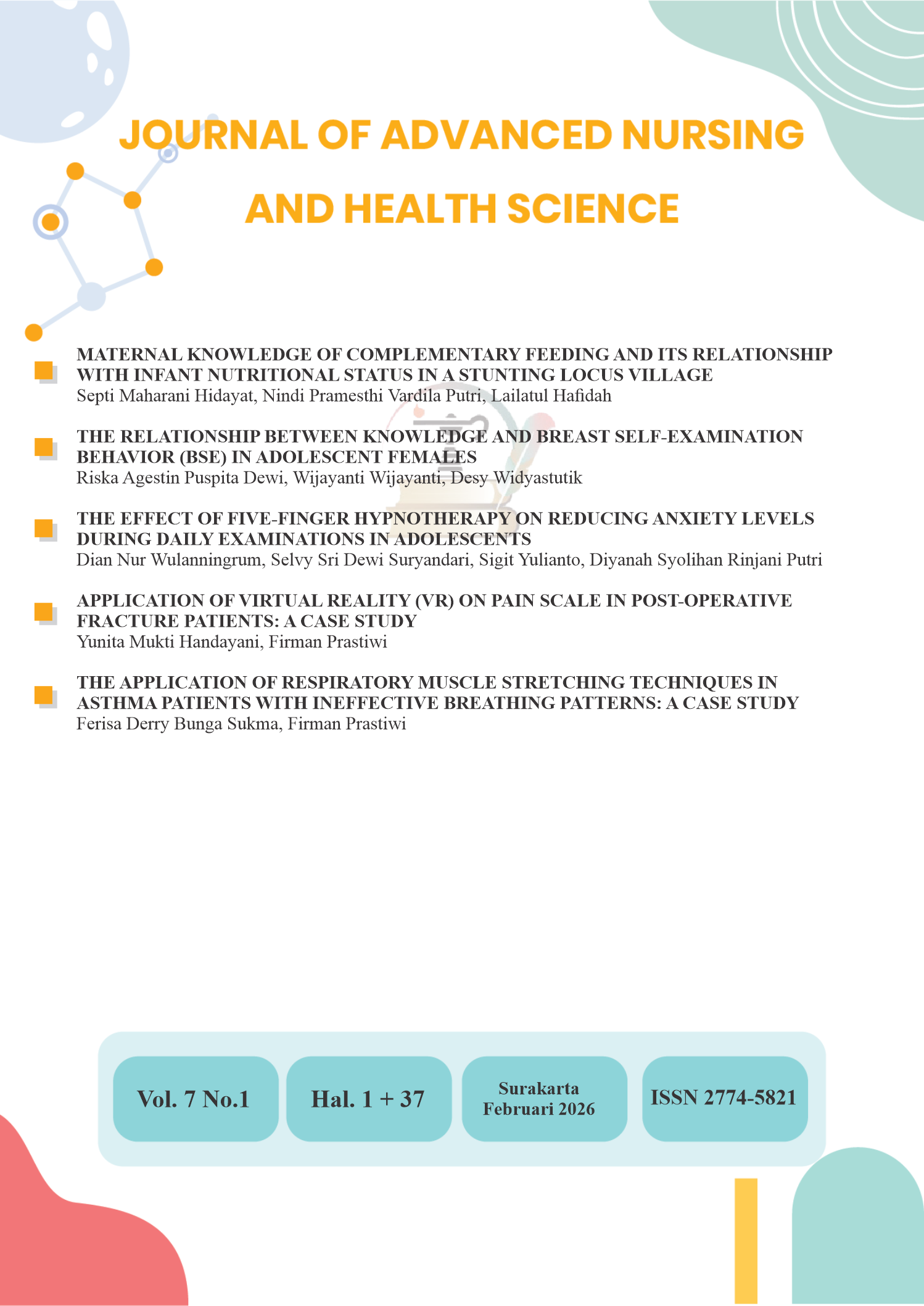
MATERNAL KNOWLEDGE OF COMPLEMENTARY FEEDING AND ITS RELATIONSHIP WITH INFANT NUTRITIONAL STATUS IN A STUNTING LOCUS VILLAGE
DOI:
https://doi.org/10.34035/kn.v7i1.1965Keywords:
complementary feeding, infant nutritional status, maternal knowledge, stuntingAbstract
Background: Nutritional problems in infants can negatively affect growth and development, including the risk of stunting. Maternal knowledge plays an important role in shaping feeding practices, yet many mothers still lack an adequate understanding of proper complementary feeding. This study aimed to examine the relationship between maternal knowledge of complementary feeding and infant nutritional status in a village with the highest stunting prevalence in Pamekasan Regency.
Methods: A correlational analytic study design was employed, involving 54 mothers with infants aged 6–23 months selected through total sampling. Maternal knowledge was assessed using a closed-ended multiple-choice questionnaire, while infant nutritional status was evaluated using weight-for-age (WFA) Z-scores calculated with WHO Anthro version 3.2.2. Data were analyzed using the Spearman rank correlation test.
Results: The results showed a weak, non-significant negative correlation (r = −0.212; ρ = 0.124).
Conclusion: Although no significant association was found, maternal education on complementary feeding should be strengthened. Nutrition programs should also address broader determinants, such as food access, caregiving practices, and health service utilization, to improve infant nutritional outcomes in stunting areas.
References
Anderson, C. E., Whaley, S. E., & Goran, M. I. (2024). The neighborhood food environment modifies the association between infant feeding and childhood obesity. BMC Public Health, 24(1). https://doi.org/10.1186/s12889-024-18755-9
Chakona, G. (2020). Social circumstances and cultural beliefs influence maternal nutrition, breastfeeding, and child feeding practices in South Africa. Nutrition Journal, 19(1). https://doi.org/10.1186/s12937-020-00566-4
Chen, Y., Guo, Y., Wu, Y., Medina, A., Zhou, H., & Darmstadt, G. L. (2024). Maternal empowerment, feeding knowledge, and infant nutrition: Evidence from rural China. Journal of Global Health, 14. https://doi.org/10.7189/JOGH.14.04094
Dinkes Jatim. (2023). Profil Kesehatan Provinsi Jawa Timur. 131–134.
Ghozali. (2018). Aplikasi analisis multivariate dengan program IBM SPSS 21. Semarang: Badan Penerbit Universitas Diponegoro.
Ginting, W. M., & Br Hutabarat, F. (2025). The Relationship Between Maternal Nutritional Knowledge and Maternal Behavior on the Nutritional Status of Children Under Five at the Blangkejeren City Health Center. JURNAL KESMAS DAN GIZI (JKG), 8(1). https://doi.org/10.35451/8jhnk558
Ismiyanti, D., Al-faida, N., & Pratama, G. (2023). Hubungan Pengetahuan Ibu Tentang Pemberian Mp-Asi Wilayah Kerja Uptd Puskesmas Bumiwonorejo Kabupaten Nabire. Jurnal Ilmiah Kesehatan Husada Askara, 9(1), 65–71. https://doi.org/10.35329/jkesmas.v9i1.3916
Keats, E. C., Neufeld, L. M., Garrett, G. S., Mbuya, M. N. N., & Bhutta, Z. A. (2019). Improved micronutrient status and health outcomes in low-and middle-income countries following large-scale fortification: Evidence from a systematic review and meta-Analysis. American Journal of Clinical Nutrition, 109(6). https://doi.org/10.1093/ajcn/nqz023
Kemenkes RI. (2021). Pedoman Pemantauan Pertumbuhan. In Kemenkes.
Kemenkes RI. (2022). Hasil Survei Status Gizi Indonesia (SSGI) 2022. Kemenkes, 1–150.
Kemenkes RI. (2024). Seperti Apa Masalah Status Gizi pada Balita? Yankes Kemenkes.
Kusfriyadi, M. K., Sugiyanto, S., & Dewi, F. U. (2019). Pengaruh Pendampingan Kader Terhadap Perilaku Gizi Ibu Dan Status Gizi Balita. MNJ (Mahakam Nursing Journal), 2(5), 187. https://doi.org/10.35963/mnj.v2i5.146
Marsita S. L, D. (2019). Hubungan Antara Pengetahuan Gizi Ibu Dengan Status gizi Anak Usia 12-24 bulan di wilayah Kerja Puskesmas Tateli kecamatan Mandolang Status gizi ialah suatu keadaan tubuh seseorang akibat mengkonsumsi berbagai sumber energi , yang berfungsi sebagai pertum. Kesehatan, Fakultas Universitas, Masyarakat Ratulangi, Sam, 8(7), 266–270.
Nabiella, A., Afifah, E., Nurlita, S., Hidayanti, M., Mumtaz, H. H., & Aji, A. S. (2025). Analysis of providing complementary feeding practice to stunted and non-stunted children aged 6-24 months in Natuna Regency, Indonesia: A qualitative study. Jurnal Gizi Indonesia (The Indonesian Journal of Nutrition), 14(1). https://doi.org/10.14710/jgi.14.1.36-50
Nataningtyas, C. D., Kumalasari, D., Kurniasari, M. A., & Putri, E. R. T. (2024). FACTORS AFFECTING EARLY COMPLEMENTARY FEEDING OF MOTHERS WITH BABIES AGED 0-6 MONTHS. Indonesian Midwifery and Health Sciences Journal, 8(1). https://doi.org/10.20473/imhsj.v8i1.2024.54-63
Notoatmodjo, S. (2012). Promosi Kesehatan dan Perilaku Kesehatan. In Journal of Chemical Information and Modeling. https://doi.org/10.1017/CBO9781107415324.004
Putri, N. F., Anna, C., Afifah, N., Gizi, P. S., & Ilmu, F. (2023). Hubungan Pengetahuan Gizi Ibu Dan Praktik Pemberian Makanan Pendamping Asi ( Mpasi ) Dengan Status Gizi Anak Usia 6-24 Bulan Di Kelurahan Simolawang Relationship Between Maternal Nutrition Knowledge and Complementary Feeding. 03(November), 1–10.
Putri, S. A., Novayelinda, R., Zukhra, R. M., & Hasneli, Y. (2025). Survei Kejadian Growth Faltering Pada Anak Usia 6–12 Bulan di Kota Pekanbaru. Malahayati Nursing Journal, 7(6). https://doi.org/10.33024/mnj.v7i6.20500
Rakotomanana, H., Hildebrand, D., Gates, G. E., Thomas, D. G., Fawbush, F., & Stoecker, B. J. (2020). Maternal Knowledge, Attitudes, and Practices of Complementary Feeding and Child Undernutrition in the Vakinankaratra Region of Madagascar: A Mixed-Methods Study. Current Developments in Nutrition, 4(11). https://doi.org/10.1093/cdn/nzaa162
Rossa Rahmadia, Z., & Mardiyah, S. (2022). Faktor Yang Berhubungan Dengan Kejadian Gizi Lebih Pada Balita Di Kelurahan Sungai Bambu. Hearty, 11(1), 114. https://doi.org/10.32832/hearty.v11i1.5554
Sahoo, J., Singh, U., Chaudhary, G., & Kumari, P. (2024). Assessment of nutritional status of infants and young children in Khodawanpur block, Begusarai district, Bihar. International Journal of Advanced Biochemistry Research, 8(2S). https://doi.org/10.33545/26174693.2024.v8.i2se.587
Sugiyono. (2022). Metode penelitian kuantitatif kualitatif dan R&D. In Penerbit Alfabeta. https://doi.org/WWW.cvalfabeta.com
UNICEF. (2020). Improving Young Children’s Diets During The Complementary Feeding Period. UNICEF Programming Guidance.
Waqiyah, H., Maineny, A., & Nurfatimah, N. (2023). The Relationship between the Timing of Complementary Feeding and Maternal Knowledge of Responsive Feeding and the Incidence of Stunting in Children Aged 6-24 Months. Poltekita : Jurnal Ilmu Kesehatan, 17(1). https://doi.org/10.33860/jik.v17i1.1889
WHO. (2023). WHO Guideline For Complementary Feeding Of Infants And Young Children 6–23 Months Of Age. In World Health Organization.
World Health Organization. (2023a). Level and trend in child malnutrition. World Health Organization, 4.
World Health Organization. (2023b). WHO Guideline for complementary feeding of infants and young children 6–23 months of age. In 2023.
Downloads
Published
Issue
Section
License
Copyright (c) 2026 Journal of Advanced Nursing and Health Sciences

This work is licensed under a Creative Commons Attribution 4.0 International License.
The copyright of the published articles belongs to Journal of Advanced Nursing and Health.

This work is licensed under a Creative Commons Attribution 4.0 International License.